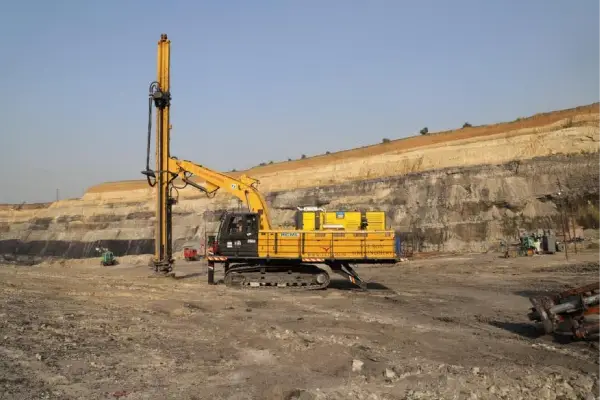
Water drilling rigs are vital equipment that is used to tap underground water sources and use it in households, agriculture, industry, and municipalities. In the past, the industry has come up with different types of drilling rigs based on the geology, depth of drilling, and nature of the project. All of them have their merits and drawbacks, so it is significant to select the appropriate rig depending on where the well is going to be drilled and what its purpose is. The following are the best drilling rigs of water wells and their use in practise.
DOWN-THE-HOLE (DTH) DRILLING RIGS
DTH rigs are percussion and rotary drills. A hammer is positioned just above the drill bit and gives it strong hits as the drill bit turns. Compressed air is used to hit the drill bit directly at the down-the-hole hammer, which gives it high impact energy to penetrate rock.
Applications:
- Extremely hard rock
- Deep borewells in rocky terrain
- High-precision wells
- Construction and mining applications
DTH rigs are popular in regions with granite, basalt, and other tough formations due to their efficiency and drilling accuracy.
ROTARY DRILLING RIGS
Rotary drilling rigs are some of the most popular rigs used in drilling of water wells. They work by spinning a drill bit attached to a long drill pipe and cut through the soft soil and hard rock formation. The drill bit is rotated with a rotary mechanism when drilling mud or air is passed using the drill to cool the bit and bring cuttings to the surface.
Applications:
- Deep water wells
- Hard rock formations
- Large-diameter wells
- Municipal or industrial water supply projects
Rotary rigs are preferred when high penetration speed and deeper drilling are required.
AUGER DRILLING RIGS
Auger rigs cover a screw blade helicially or corkscrew-like into the ground. They are most applicable to soft soils and to shallow wells. The auger causes the borehole to clear as the rotating auger pulls up loose soil along its blades.
Applications:
- Shallow water wells
- Soil investigation and environmental studies
- Soft soil and clay areas
- Agricultural and domestic water supply
Auger rigs are cost-effective but have limited depth capacity.
TRUCK-MOUNTED AND TRAILER-MOUNTED DRILLING RIGS
These rigs refer to rigs that are mounted on trucks or trailers for easy transportation and rapid deployment.
Applications:
- Remote or multiple drilling locations
- Fast setup and movement
- Large agricultural or commercial drilling projects
They combine mobility with power, making them ideal for field operations.
DIRECT MUD ROTARY DRILLING RIGS
These are another type of rotary rigs that utilise a constant stream of drilling mud in order to lubricate the bit, stabilise the borehole and transport cuttings to the surface. The circulation of drilling mud in the drill pipes cools the bit and supports unstable formations.
Applications:
- Loose or unconsolidated soils
- Deep wells with risk of collapse
- Irrigation and municipal water wells
Mud rotary rigs come in handy especially in sandy or gravelly formations.
FINAL WORD
The selection of the appropriate water well drilling rig will be based on the geological factors, required depth, project size and budget. Rotary rigs are the most suitable in deep and hard rock wells whereas auger rigs are suitable in shallow and soft soils. DTH and air rotary rigs are superior in steep rocky conditions and cable tool rigs are not only dependable in low-cost and accuracy in drilling. The knowledge of these types can be used to make sure that the construction of water wells is efficient, safe and successful.
Related Link: HOW BOREHOLE DRILLING RIGS ARE REVOLUTIONIZING WATER EXTRACTION IN INDIA